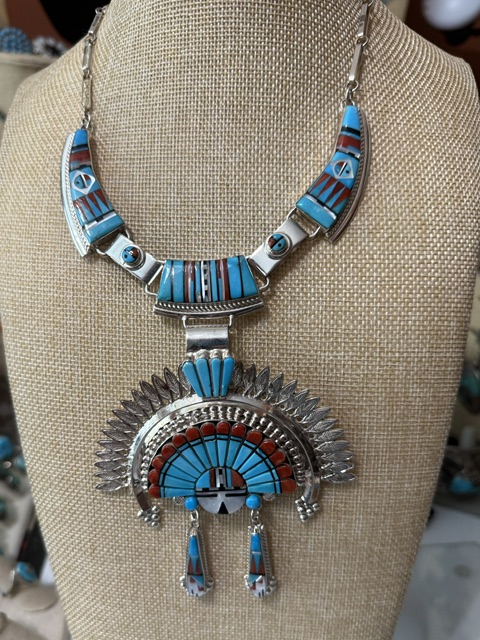
The Ancient Origins of Turquoise at Zuni
Long before Europeans introduced silverworking to the Southwest, the ancestors of today's Zuni people were already masters of working stone.
Archaeological evidence shows that turquoise was mined, traded, carved, and worn throughout the Southwest for well over a thousand years. Ancient Pueblo peoples shaped turquoise using sandstone, antler tools, wooden drills, and abrasive sand, creating beads, pendants, ceremonial objects, and trade items.
Turquoise was never merely decorative.
To the Zuni people, it represented:
-
Rain
-
Life
-
Protection
-
Fertility
-
Harmony
-
Spiritual balance
Even today, turquoise remains one of the most culturally significant stones in Zuni jewelry.
The Arrival of Silver
Although turquoise had been used for centuries, silver did not arrive until the late 1800s.
Around 1872, a Zuni man named Lanyade became the first known Zuni silversmith after learning silverworking techniques from Navajo craftsmen. He later taught many others within the Pueblo, helping establish an entirely new artistic tradition. (Wikipedia)
Only a few decades later, another pioneering artist, Kineshde (Keneshde), is credited with being the first Zuni jeweler to combine turquoise with silver settings, creating a style that would forever define Zuni jewelry. (Wikipedia)
Why Zuni Artists Became the World's Finest Lapidaries
Unlike many Southwestern tribes whose artistry emphasized heavy silverwork, Zuni artists became famous for something different:
Stone.
Their incredible ability to cut, shape, polish, and fit tiny stones together became legendary.
This mastery eventually produced several iconic Zuni techniques.
Petit Point
Tiny hand-cut oval turquoise stones individually set into silver.
Each stone must be perfectly matched in color, size, and shape.
Needlepoint
Even more difficult than petit point.
Each stone is hand-cut into long, narrow points that radiate around a design.
Authentic needlepoint requires extraordinary patience and precision.
Cluster Work
Multiple turquoise stones arranged in symmetrical floral or sunburst patterns.
Cluster jewelry became one of the defining styles of vintage Zuni jewelry during the early twentieth century.
Channel Inlay
Small stones are carefully fitted inside silver channels with virtually invisible gaps.
The result is smooth, geometric artwork requiring immense precision.
Mosaic Inlay
Perhaps the most celebrated Zuni art form.
Tiny pieces of turquoise, coral, jet, mother-of-pearl, sugilite, shell, and other natural materials are cut by hand and assembled like an intricate puzzle.
Many collectors consider Zuni mosaic inlay to be among the finest stone craftsmanship in the world.
The Influence of Trading Posts
During the early twentieth century, trading posts became important centers for Native American jewelry.
One of the most influential figures was trader C.G. Wallace, who encouraged innovation while helping bring Zuni jewelry to a national audience. Wallace supplied turquoise, silver, tools, and encouraged artists to refine techniques such as petit point, needlepoint, and intricate inlay that appealed to collectors. (Wikipedia)
Although tourism helped expand the market, Zuni families preserved their artistic traditions through generations of teaching within families and clans.
Legendary Historic Zuni Artists
Many artists helped shape the history of Zuni jewelry.
Among the most celebrated are:
These pioneers established styles that remain highly collectible today.
Modern Masters Keeping the Tradition Alive
The beauty of Zuni jewelry is that it continues to evolve while honoring centuries of tradition.
Today's award-winning artists create museum-quality works that blend ancestral techniques with contemporary creativity.
Quintin Quam
Quintin Quam has become internationally respected for his astonishing mosaic and animal inlay jewelry.
His hummingbirds, bears, wolves, fish, turtles, dragonflies, and other wildlife pieces display extraordinary precision and color balance.
Many collectors consider his work among the finest examples of modern Zuni lapidary art.
Patty Edaakie & Rayland Edaakie
Award-winning husband-and-wife artists Patty and Rayland Edaakie are admired for breathtaking mosaic inlay that combines traditional Zuni symbolism with flawless craftsmanship.
Their jewelry often incorporates turquoise alongside coral, jet, mother-of-pearl, and shell to create rain clouds, sun faces, sacred symbols, and geometric designs that celebrate Zuni culture.
Quandalacy Quam
Representing the newest generation of talented Zuni artists, Quandalacy Quam continues the Pueblo's rich family tradition of exceptional lapidary work.
Combining precision stone cutting with modern artistic vision, Quandalacy's jewelry reflects both innovation and deep respect for ancestral craftsmanship.
Why Collectors Love Vintage Zuni Jewelry
Collectors appreciate Zuni jewelry because no two handmade pieces are exactly alike.
Authentic Zuni jewelry often features:
-
Hand-cut natural turquoise
-
Artist signatures
-
Handmade sterling silver
-
Family traditions spanning generations
-
Extraordinary stone matching
-
Precision craftsmanship impossible to duplicate by machine
Older vintage pieces frequently display remarkable turquoise from historic American mines that are now closed, making them increasingly desirable.
The Future of Zuni Turquoise Jewelry
Despite changing markets and modern technology, Zuni jewelry remains rooted in tradition.
Young artists continue learning from parents, grandparents, aunts, uncles, and elders.
Every carefully cut stone honors generations who perfected these techniques over hundreds of years.
When you purchase authentic Zuni jewelry, you're not simply buying turquoise.
You're preserving one of North America's greatest artistic traditions.
Frequently Asked Questions
Is Zuni jewelry handmade?
Yes. Authentic Zuni jewelry is traditionally handcrafted by Native American artists using techniques passed down through generations. While some artists incorporate modern tools, the stone cutting, fitting, and finishing remain highly skilled handwork.
Why is Zuni jewelry famous?
Zuni artists are internationally recognized for their exceptional lapidary skills, especially mosaic inlay, channel inlay, petit point, needlepoint, and cluster work.
What turquoise is used in Zuni jewelry?
Historically and today, Zuni artists have used turquoise from many Southwestern mines, including Kingman, Sleeping Beauty, Bisbee, Morenci, Lone Mountain, Number Eight, and others, depending on availability and artistic preference.
Is vintage Zuni jewelry valuable?
Yes. Vintage Zuni jewelry by well-known artists can be highly collectible, especially pieces with documented provenance, exceptional craftsmanship, rare turquoise, and original artist signatures.
Experience Authentic Zuni Jewelry at Jewelry Roadshow Live
At Jewelry Roadshow Live (JRSL), we believe every piece of Native American jewelry carries a story worth sharing. From vintage treasures to contemporary masterpieces by celebrated Zuni artists, our goal is to connect collectors with authentic, artist-made jewelry while educating our community about its history, craftsmanship, and cultural significance.
Whether you're searching for a delicate petit point ring, a museum-quality mosaic inlay pendant, or a one-of-a-kind turquoise bracelet, every authentic Zuni piece represents generations of artistry that continue to thrive today. Visit us at Jewelry Roadshow or on Facebook FACEBOOK JRSL
Collect the art. Learn the history. Preserve the tradition.